Everything You Need to Know When Buying Colt Python 357 Online in America
The Colt Python 357 is one of the most legendary revolvers ever made in the United States. Chambered in .357 Magnum, it was first built in 1955 by Colt’s Manufacturing Company in West Hartford, Connecticut — and it is still being made today. Colt Python 357 For Sale USA
For American gun owners, collectors, and competitive shooters, the Python holds a special place. It is known across the country for three things: the smoothest factory trigger on any production revolver, precision accuracy, and beautiful craftsmanship. Whether you are buying your first revolver or adding to a serious collection, the Colt Python 357 deserves your attention.
Why the Colt Python 357 Is So Famous in America
The Python did not become famous by accident. It became the gold standard of American revolvers because of how it was made. In an era when most revolvers were produced quickly and cheaply, Colt assigned skilled gunsmiths to hand-fit and hand-polish every Python before it left the factory. Each gun took more time to build than any other Colt revolver, and the results showed. Where Can I Buy Colt Python 357 in USA
By the 1960s and 1970s, American law enforcement agencies, competitive shooters, and serious gun owners were buying Pythons in large numbers. It became the go-to revolver for people who wanted the best — and that reputation has never faded.
When Colt stopped making the Python in 1999 (and finally ended Custom Shop production in 2005), used Pythons immediately became collector’s items. Prices shot up. Demand never dropped. And in January 2020, Colt answered America’s call and brought the Python back — modernized, stronger, and better than ever.
Colt Python 357 History: From 1955 to Today
First Generation (1955–1999)
The Colt Python was introduced in 1955 as the company’s top-of-the-line revolver. It was originally designed as a target revolver built around the .357 Magnum cartridge — powerful, accurate, and smooth.
A few key facts about the first generation:
- Only one Python was built in 1955. Over 300 were built by the end of 1956.
- By 1969, more than 100,000 Pythons had been manufactured.
- Starting in the 1970s, Colt became the first revolver maker to laser-boresight every Python at the factory.
- In 1997, the Python moved to the Colt Custom Shop, where it was renamed the Python Elite.
- In October 1999, Colt announced the end of Python production. The Custom Shop continued small-run production until 2005.
Second Generation (2020–Present)
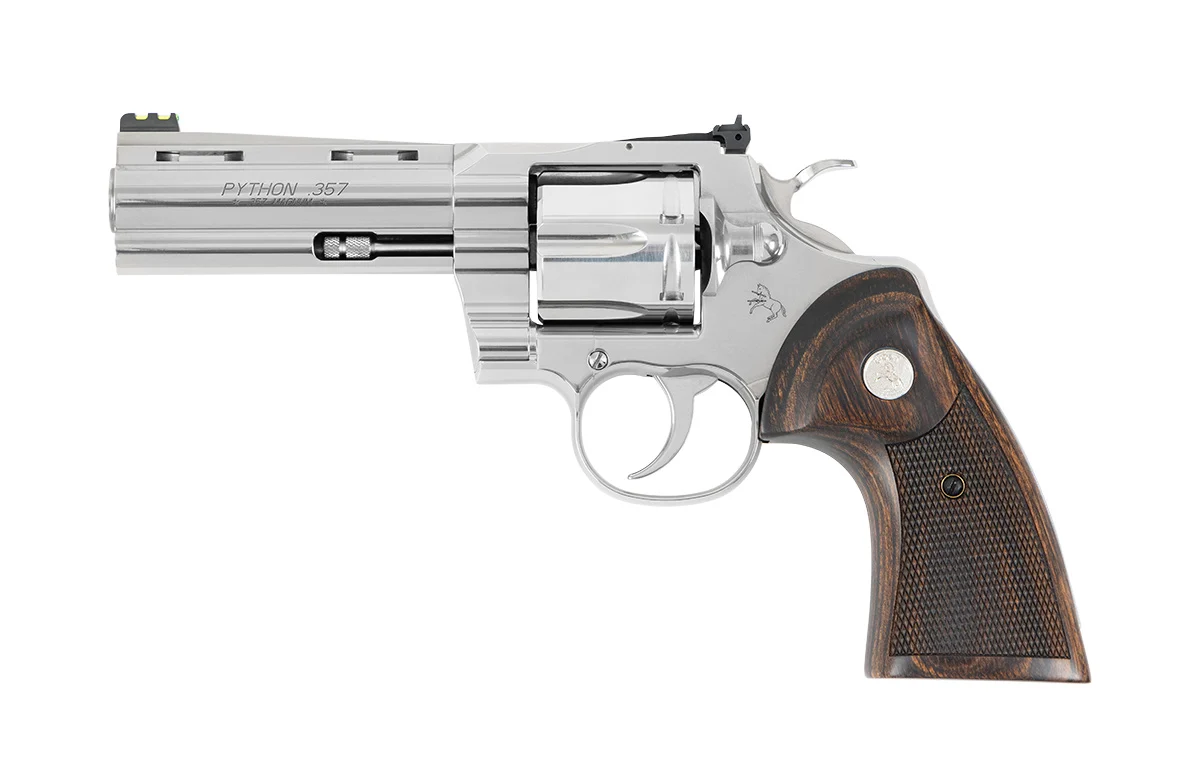
Colt relaunched the Python in January 2020, rebuilt from the ground up using modern CNC machining and updated metallurgy. The new Python is made from stronger stainless steel, features a redesigned trigger mechanism that eliminates stacking, and includes 30% more steel in the top strap for greater durability with full-power .357 Magnum loads. Colt Python 357 For Sale USA
In 2024, Colt expanded the line with a blued finish Python — the classic deep blue look that fans had been requesting for years. In 2025, even more barrel lengths and finish options were added to the Python lineup.
Full Specifications
Stainless Python (2020–Present)
| Specification | 3″ Model | 4.25″ Model | 5″ Model | 6″ Model | 8″ Model |
|---|---|---|---|---|---|
| Caliber | .357 Mag / .38 Spl | .357 Mag / .38 Spl | .357 Mag / .38 Spl | .357 Mag / .38 Spl | .357 Mag / .38 Spl |
| Action | DA / SA | DA / SA | DA / SA | DA / SA | DA / SA |
| Cylinder | 6 rounds | 6 rounds | 6 rounds | 6 rounds | 6 rounds |
| Overall Length | 7.9″ | 9.75″ | 10.5″ | 11.5″ | 13.5″ |
| Weight (Unloaded) | 36 oz | 42 oz | 43 oz | 46 oz | 52 oz |
| Frame | Stainless Steel | Stainless Steel | Stainless Steel | Stainless Steel | Stainless Steel |
| Finish | High-polish stainless | High-polish stainless | High-polish stainless | High-polish stainless | High-polish stainless |
| Grips | Walnut target stocks | Walnut target stocks | Walnut target stocks | Walnut target stocks | Walnut target stocks |
| Front Sight | Interchangeable red ramp | Interchangeable red ramp | Interchangeable red ramp | Interchangeable red ramp | Interchangeable red ramp |
| Rear Sight | Adjustable target | Adjustable target | Adjustable target | Adjustable target | Adjustable target |
| Rifling | 6-groove, 1:14″ LH | 6-groove, 1:14″ LH | 6-groove, 1:14″ LH | 6-groove, 1:14″ LH | 6-groove, 1:14″ LH |
Blued Python (2024–Present)
| Specification | Details |
|---|---|
| Frame | Carbon steel, blued |
| Finish | High-polish deep blue |
| Grips | Altamont solid walnut with gold rampant Colt medallions |
| Barrel Lengths Available | 2.5″, 3″, 4.25″, 5″, 6″, 8″ |
| MSRP | $1,699 |
| Trigger (Double-Action) | 9 lbs, 9 oz (average) |
| Trigger (Single-Action) | 5 lbs, 6 oz (average) |
Colt Python 357 Trigger
If you only remember one thing about the Colt Python 357, remember this: it has the smoothest double-action trigger of any factory production revolver available in America today.
The trigger is the Python’s crown jewel. In double-action mode, the pull is consistent, smooth, and free of stacking — meaning the weight does not suddenly spike at the end of the stroke the way it does on many other revolvers. The single-action pull is crisp and light. Colt Python 357 Price in the USA
How does this compare to other popular revolvers?
| Revolver | DA Trigger | SA Trigger |
|---|---|---|
| Colt Python 357 | ~9–9.5 lbs, ultra-smooth | ~3–5.5 lbs, crisp |
| S&W 686 | ~9–10 lbs, good | ~4 lbs |
| Ruger GP100 | ~11–12 lbs, heavier | ~4.5 lbs |
The Python’s trigger advantage is real and consistently confirmed by independent testers and shooters across the country. Out of the box — with zero modifications — the Colt Python’s trigger outperforms its rivals.
Colt Python 357 Barrel Lengths: Which Is Right for You?
One of the best things about buying a Colt Python 357 today is the variety of barrel lengths available. Here is what each one offers:
2.5 Inch
Available on the blued Python only (2025). Compact for carry, with classic lines and traditional panel grips. A rare and collectible configuration, especially popular with fans of original first-generation Pythons.
3 Inch
A limited-production model that became an instant hit with collectors and carry enthusiasts. It is the smallest stainless Python regularly produced. At 36 ounces, it is lighter than the longer versions while still delivering serious .357 Magnum power. Colt Python 357 For Sale USA
4.25 Inch
The most popular all-around Python. At 42 ounces and 9.75 inches overall, it is perfectly balanced in the hand. Great for home defense, range shooting, and everyday ownership. The most widely available version and the one most buyers choose first.
5 Inch
An often-overlooked option that many experienced shooters call the sweet spot. The extra barrel length over the 4.25″ version adds sight radius and velocity without making the gun significantly harder to handle. One NRA reviewer called it “perfectly balanced” with an almost ideal combination of size, weight, and accuracy.
6 Inch
The classic Python configuration. Most vintage photos and pop culture appearances of the Python feature the 6-inch barrel. Great for target shooting, hunting, and collecting. Adds noticeable velocity to .357 Magnum ammunition compared to shorter barrels.
8 Inch
The longest Python available. Maximizes .357 Magnum velocity for hunting applications. A serious range gun and an eye-catching collector piece. Heavy at 52 ounces but delivers the best precision accuracy of any Python configuration. Colt Python 357 Online Shop in USA
Colt Python 357 Finish Options: Blued vs Stainless vs Matte
High-Polish Stainless Steel
The standard finish since the 2020 reintroduction. Extremely durable, corrosion-resistant, and low maintenance. The right choice for regular shooters who want to use their Python without worrying about finish wear.
Blued (Carbon Steel)
Reintroduced in 2024 after enormous demand from collectors and Python fans. The deep, rich blue finish is closer to the look of original first-generation Pythons. The blued models feature walnut grips with gold rampant Colt medallions — one of the most beautiful-looking production revolvers available in America today. Best for collectors and display alongside regular shooting use. Colt Python 357 Dealer Near Me
Matte Stainless
A brushed matte finish introduced in 2024. Priced at $1,299, it is the most affordable Python in the current lineup. Available in multiple barrel lengths with orange-insert front sights. Less flashy but fully functional for regular range use.
Colt Python 357 For Sale USA
Colt Python 357 Price
New Production Pythons
| Model | MSRP |
|---|---|
| Stainless Python (4.25″ or 6″) | $1,499–$1,699 |
| Blued Python (all barrel lengths) | $1,699 |
| Matte Python (all barrel lengths) | $1,299 |
Street prices at licensed US dealers typically run $1,300–$1,700 depending on the model, barrel length, and local availability.
Performance
Reliability
The second-generation Python is highly reliable. Independent reviews testing 500 to 1,200 rounds through the new Python consistently report zero malfunctions. Early 2020 production guns had some reported timing issues, but Colt addressed these quickly. Current production Pythons are dependable across both .38 Special and .357 Magnum loads.
Accuracy
At 25 yards from a bench rest in single-action mode, the Python consistently delivers groups under one inch with quality ammunition. The adjustable rear sight and user-interchangeable front sight allow precise zeroing for different loads and distances.
Recoil
The Python’s weight works in your favor. The 42-ounce 4.25″ model absorbs recoil well. With .38 Special loads, the walnut grips feel comfortable for long range sessions. With full-power .357 Magnum loads, many owners swap the walnut grips for rubber grips. The original Python grip frame dimensions are unchange, so all vintage aftermarket grip options still fit the new gun. Order Colt Python 357 Online in USA
One Thing to Know
The ejector rod on the Python is too short to fully eject .38 Special cases from the cylinder. You need to tilt the gun upward and give the rod a firm push. This is not a defect — it has been part of the Python’s design since 1955. Every Python owner learns this quickly.
Colt Python 357 vs. Smith & Wesson 686
The S&W 686 is the most common comparison to the Python in the US market. Here is how they compare honestly:
| Feature | Colt Python 357 | S&W 686 Plus |
|---|---|---|
| Caliber | .357 Mag / .38 Spl | .357 Mag / .38 Spl |
| Cylinder Capacity | 6 rounds | 7 rounds |
| Price (new) | $1,299–$1,699 | $800–$1,000 |
| Trigger (out of box) | Best in class | Very good |
| Frame | Stainless or blued steel | Stainless steel |
| Aftermarket Parts | Limited | Very large |
| Collector Value | Very high | Moderate |
| Best For | Collectors, serious shooters | Duty use, everyday shooters |
Bottom line: The Python wins on trigger feel, aesthetics, and collector value. The 686 wins on price, ammo capacity, and aftermarket support. Both are American-made revolvers that will last a lifetime — but they serve somewhat different owners.
Colt Python 357 vs. Ruger GP100
The Ruger GP100 is the Python’s other major rival in the US .357 Magnum market:
| Feature | Colt Python 357 | Ruger GP100 |
|---|---|---|
| Caliber | .357 Mag / .38 Spl | .357 Mag / .38 Spl |
| Cylinder Capacity | 6 rounds | 6 rounds |
| Price (new) | $1,299–$1,699 | $700–$900 |
| Trigger (out of box) | Best in class | Heavy, good after tuning |
| Durability | High | Very high |
| Aftermarket Parts | Limited | Extensive |
| Collector Value | Very high | Low to moderate |
| Best For | Collectors, range shooting | Heavy use, budget-conscious buyers |
Bottom line: The GP100 is built like a tank and is the right choice if you plan to shoot thousands of heavy Magnum loads or want a workhorse revolver at a lower price. The Python is the right choice if you want the best factory trigger available and a revolver with real collector and investment value. Can I Buy Colt Python 357 in USA Online
The real-world verdict from US reviewers: Out of the box, with no modifications, the Colt Python is the best-shooting .357 Magnum production revolver available in America. Both the GP100 and the 686 need aftermarket trigger work to approach what the Python delivers from the factory.
What the Colt Python357 Magnum Cartridge Can Do
The Python’s chambering is a major part of its appeal. The .357 Magnum is one of the most versatile handgun cartridges ever develope in the United States, and the Python’s cylinder also accepts the lighter .38 Special — giving you a practical two-in-one revolver. Colt Python 357 For Sale USA
Here is what the .357 Magnum is used for by American gun owners:
- Home defense — The .357 Magnum delivers serious stopping power in a manageable package
- Concealed carry (shorter barrels) — The 3-inch Python with .38 Special loads is a capable carry option
- Range shooting and target practice — Use cheaper .38 Special for practice, .357 Magnum for power
- Hunting — Deer and hog hunters use 6″ and 8″ Pythons with full-power loads
- Collecting — The Python is one of the most recognized and desirable American revolvers at any price point
Who Should Buy the Colt Python 357?
American Collectors — The Python is a cornerstone of any serious American revolver collection. Vintage models continue to appreciate in value, and new production Pythons pair beautifully alongside them.
Serious Range Shooters — If you want the smoothest, most satisfying double-action trigger available on a production revolver, the Python is the answer. Nothing manufactured today beats it out of the box.
Home Defense Owners — The 4.25-inch Python with .357 Magnum or .38 Special ammunition is a capable, reliable home defense firearm.
First-Time Revolver Buyers — If your budget allows, starting with a Python means starting with the best. The trigger teaches you what a great revolver feels like.
Pop Culture Fans — The Colt Python is the revolver carry by Rick Grimes in The Walking Dead, arguably the most recognizable revolver in recent American pop culture. Its appearance in TV, movies, and video games has introduced it to a whole new generation of American gun owners. Colt Python 357 For Sale USA
Frequently Asked Questions (FAQs) by Americans
What caliber is the Colt Python 357?
The Colt Python 357 is chambered in .357 Magnum. It also accepts .38 Special ammunition, which is less powerful, less expensive, and easier to shoot for practice.
Is the Colt Python 357 still being made?
Yes. Colt reintroduced the Python in January 2020 and continues to expand the lineup. In 2025, the Python family includes stainless, blued, and matte finishes across multiple barrel lengths.
How much does the Colt Python 357 cost in the USA?
New Pythons range from $1,299 (matte finish) to $1,699 (blued or current stainless models). Used second-generation models sell for $900–$1,400. Vintage first-generation models can cost $2,000 to over $50,000 depending on condition and rarity.
What are the available barrel lengths for the Colt Python 357?
The current Python lineup includes 2.5″, 3″, 4.25″, 5″, 6″, and 8″ barrel lengths depending on the finish and configuration.
What is the best barrel length for the Colt Python 357?
The 4.25-inch is the most popular and versatile all-around choice. The 6-inch is prefer for target shooting and collecting. The 5-inch is praise by experience shooters as the ideal balance. The 3-inch is the collector’s carry favorite.
Is the new Colt Python 357 as good as the vintage model?
The new Python has a trigger that is equal to or better than most original Pythons, and it is made from stronger steel that handles modern .357 Magnum loads more reliably. It is a different gun internally but delivers the same legendary shooting experience at roughly one-third the cost of a clean vintage model.
What is the difference between the blued and stainless Colt Python?
The stainless Python uses a high-polish stainless steel frame and is highly corrosion-resistant. The blued Python uses a carbon steel frame with a deep blue finish that matches the look of original first-generation Pythons. Blued models also feature walnut grips with gold Colt medallions.
How does the Colt Python 357 compare to the S&W 686?
The Python has a smoother factory trigger, higher collector value, and more prestigious heritage. The 686 holds 7 rounds vs the Python’s 6, costs roughly half as much, and has far more aftermarket support. Both are excellent — the choice depends on your priorities.
Can you use the Colt Python 357 for concealed carry?
The shorter Python models (3″ barrel) can be use for conceal carry, though at 36+ ounces they are on the heavier side. Many owners prefer to use their Python as a range or home defense gun and carry a smaller revolver for daily concealed carry. Colt Python 357 For Sale USA
Colt Python 357 Maintenance Tips
Keeping your Python in top condition is straightforward:
- Clean after every range session — Wipe down all metal surfaces, clean the forcing cone and cylinder chambers, and lightly oil the action.
- Pay attention to the forcing cone — The area where the barrel meets the cylinder takes the most abuse with .357 Magnum loads. Inspect and clean it regularly.
- Use .38 Special for practice — It is cheaper, lighter on recoil, and easier on the gun. Save full-power .357 Magnum for when you need it.
- Store properly — A light coat of gun oil on metal surfaces and storage in a cool, dry location will protect the finish for decades.
- Do not dry-fire excessively — While modern Pythons can handle limited dry-fire, use snap caps if you dry-fire often. Buy Colt Python 357 Online in the USA
| Options | Target Python 6, Target Python 8 |
|---|
Be the first to review “Colt Target Python in USA”
Related products
Colt Firearm For Sale in USA
Colt Firearm For Sale in USA
Colt Firearm For Sale in USA
Colt Firearm For Sale in USA
Colt Firearm For Sale in USA
Colt Firearm For Sale in USA
Colt Firearm For Sale in USA
Colt Firearm For Sale in USA
Reviews
There are no reviews yet.