
Everything You Need to Know When Buying a Colt Grizzly in America
The Colt Grizzly is one of the rarest and most sought-after names in Colt’s modern revolver history — a full-lug .357 Magnum “bear gun” originally built in extremely limited numbers by Colt’s Custom Shop in the mid-1990s, and revived as a full-production model in 2024. Like its .44 Magnum sibling the Kodiak, the Grizzly breaks from Colt’s usual snake-gun naming tradition and leans directly into a backcountry, big-game-country identity. For collectors and outdoorsmen alike, the Grizzly name carries real weight in Colt circles. Colt Grizzly For Sale in USA
Why the Colt Grizzly Matters to Collectors
Colt has built most of its modern revolver identity around snake names — Python, Cobra, King Cobra, Anaconda, Diamondback, Viper, Boa. The Grizzly and its .44 Magnum sibling, the Kodiak, are the exceptions, named instead for the animal a backcountry traveler might actually need protection from. That naming choice wasn’t incidental — both guns were build and marketed specifically around big-game hunting and wilderness protection rather than general sporting or defensive use. Colt Grizzly Price in USA
The original Grizzly’s extreme scarcity is central to its reputation. Unlike the Python or Anaconda, which had substantial multi-decade production runs, the original Grizzly existed only as a short-lived Custom Shop special, making it one of the hardest original Colt “snake gun” family revolvers to find today.
Colt Grizzly History: From the 1990s to Today
The Original Grizzly (1994–1995)
The original Colt Grizzly was build by Colt’s Custom Shop, combining a King Cobra frame with a Python-style, full-underlug barrel — a 6-inch barrel finish with factory Mag-Na-Porting, a process that vents propellant gas through ports near the muzzle to reduce muzzle rise. It featured an unfluting six-round cylinder, a matte stainless finish, and Pachmayr grips with Colt medallions.
Production numbers for the original Grizzly are genuinely disputed even among collectors and dealers. Some sources and period documentation cite a production run of 999 units built in 1994–1995; other auction houses and collector references cite a figure closer to 500. Some collector discussion suggests the two figures may reflect a combined run split between the Grizzly (6-inch barrel) and the Kodiak (4-inch barrel, in .44 Magnum) — with roughly 500 of each making up a combined total closer to 1,000. Because Colt’s own Custom Shop records on this run aren’t uniformly cite the same way across sources, buyers and collectors should treat exact production figures as approximate rather than settle fact, and should request Colt factory letters or documenting provenance when buying an original example. Colt Grizzly Online Shop in USA
Whatever the precise number, the original Grizzly is unambiguously one of the scarcest revolvers in Colt’s modern catalog, and clean, boxed examples with matching paperwork have sold in the range of several thousand dollars at auction.
The 2024 Relaunch
Colt reintroduced the Grizzly in 2024, announced at the NRA Annual Meetings in Dallas alongside the Kodiak and the returning Colt Viper. Unlike the original, which was a King Cobra-frame/Python-barrel hybrid build in the Custom Shop, the modern Grizzly is build entirely on Colt’s current Python platform — reflecting how thoroughly Colt has modernized and unified its revolver manufacturing since the Python’s own 2020 relaunch. Colt Grizzly For Sale in USA
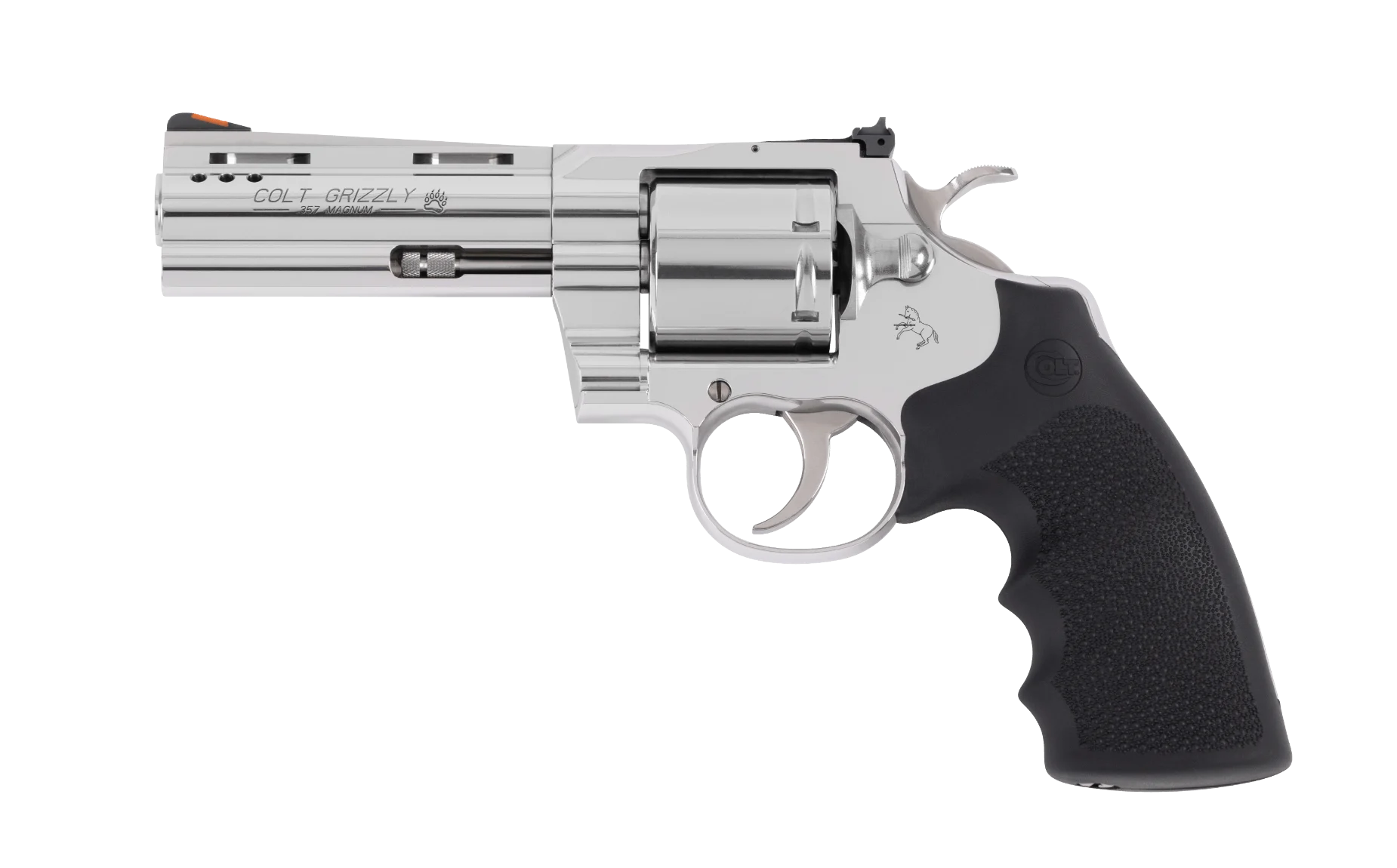
The new Grizzly retains the core identity of the original: a full-lug barrel, ventilated top rib, ported barrel for recoil mitigation, unfluted cylinder, and bear-paw rollmark on the barrel. It’s chambered in .357 Magnum (and also fires .38 Special) rather than .44 Magnum, distinguishing it from the Kodiak, which shares a very similar design language but in the larger-caliber Anaconda platform.
Colt Grizzly For Sale in USA: Full Specifications
| Specification | Details |
|---|---|
| Type | Double-action/single-action revolver |
| Caliber | .357 Magnum (also fires .38 Special) |
| Cylinder | 6-round, unfluted |
| Barrel Length | 4.25″ (current production) |
| Barrel Features | Full-length underlug, ventilated top rib, factory porting |
| Frame | Stainless steel, Python platform |
| Finish | Polished stainless with matte top rib for glare reduction |
| Sights | Adjustable rear sight, front sight optimized for sight acquisition |
| Grips | Hogue OverMolded rubber |
| Weight (unloaded) | ~41 oz |
| MSRP | $1,599 |
The original 1994–1995 Grizzly, by comparison, used a 6-inch barrel exclusively (rather than the 4.25-inch standard on current production), a King Cobra frame rather than a Python frame, and Pachmayr grips rather than Hogue. Colt Grizzly For Sale in USA
Colt Grizzly For Sale in the USA
Where To Buy Colt Grizzly in USA
Porting and the Unfluted Cylinder
As with the Kodiak, the Grizzly’s factory-ported barrel is a defining, standard feature rather than an aftermarket modification. Vent ports machined near the muzzle allow propellant gas to escape upward, helping counteract muzzle flip and reduce felt recoil — a meaningful benefit on a full-power .357 Magnum load, and part of why Colt markets the Grizzly specifically toward tough outdoors treks rather than as a general-purpose range gun.
The unfluted cylinder — solid rather than scalloped between chambers — is largely a design callback to the original Grizzly’s look, giving the gun a heavier, more substantial profile that pairs with its full-underlug barrel for a distinctly “big bore” appearance, even though the .357 Magnum chambering is lighter-recoiling than its .44 Magnum sibling. Colt Grizzly For Sale in USA
Trigger Feel
Reviewers of the 2024 Grizzly have generally described the double-action trigger pull as notably smooth, crediting Colt’s use of a leaf-style mainspring (as opposed to a coil mainspring) for minimizing “stacking” — the sensation of trigger resistance increasing sharply as the trigger nears the end of its travel. The new Grizzly also features a recessed, target-style barrel crown and an owner-replaceable front sight, both consistent with features found across Colt’s broader modern snake-gun lineup. Ca I Buy Colt Grizzly Online in USA
Colt Grizzly vs. Colt Kodiak
| Feature | Grizzly | Kodiak |
|---|---|---|
| Caliber | .357 Magnum / .38 Special | .44 Magnum / .44 Special |
| Platform | Python frame | Anaconda frame |
| Barrel Length (current) | 4.25″ | 4.25″ (standard), 6″ available |
| Cylinder | Unfluted | Unfluted |
| Barrel | Ported | Ported |
| Original Era | 1994–1995, King Cobra/Python hybrid | 1993, Anaconda-based |
| MSRP | $1,599 | $1,599 |
Bottom line: the Grizzly and Kodiak are companion models in Colt’s current lineup, sharing design philosophy (porting, unfluted cylinder, bear-themed naming) but built on different frame sizes and calibers — the Grizzly on the medium-large Python platform in .357 Magnum, the Kodiak on the larger Anaconda platform in .44 Magnum.
Colt Grizzly For Sale in USA: What the Grizzly Is Used For
- Backcountry protection — like the Kodiak, the Grizzly is marketing toward hunters, anglers, and hikers who want a manageable-but-powerful sidearm for wilderness travel.
- Hunting — .357 Magnum is a viable option for smaller game at appropriate ranges, and the Grizzly’s porting makes repeated full-power shots more manageable than an unported gun.
- Range and target shooting — the Grizzly also chambers and fires .38 Special, giving owners a lower-recoil practice option in the same gun. Colt Grizzly Near Me USA
- Collecting — both the extremely scarce original 1994–1995 Grizzly and the new 2024 production are of significant interest to Colt collectors, with the original commanding a substantial premium given its rarity.
Who Should Buy a Colt Grizzly?
Hunters and backcountry travelers who want a .357 Magnum revolver specifically built around recoil management for repeated full-power shots.
Colt collectors, particularly those building out a complete modern snake-gun collection alongside the Python, Anaconda, and Kodiak — the Grizzly is one of the newer additions to that lineup and carries genuine rarity value in its original form.
Buyers who already own a current-production Python — since the new Grizzly is built on the same platform, grip and holster compatibility carries over. Colt Grizzly Dealer in USA
Buyers who want a general-purpose .357 Magnum revolver may be better served by the standard King Cobra or Python, which offer more barrel-length options if the specific porting and unfluted-cylinder features of the Grizzly aren’t a priority.
Frequently Asked Questions by Americans
What caliber is the Colt Grizzly?
.357 Magnum. It also chambers and fires .38 Special.
Is the Colt Grizzly still being made?
Yes. Colt reintroduced the Grizzly in 2024 after the original 1990s limited run, and it remains in current production.
How many original Grizzlies were made?
Sources disagree — figures cited range from around 500 to 999, with some suggesting the two numbers may reflect a combined Grizzly/Kodiak production total rather than two separate counts for the same gun. Buyers of an original example should request documentation or a Colt factory letter rather than relying on a single cited figure.
What barrel length does the current Grizzly come in?
4.25 inches, as standard current production. The original 1994–1995 Grizzly used a 6-inch barrel exclusively.
How much does a new Colt Grizzly cost?
MSRP is $1,599. Original 1990s Grizzlies sell for significantly more on the collector market — commonly several thousand dollars for clean, documented examples — reflecting their scarcity.
What’s the difference between the Grizzly and the Kodiak?
The Grizzly is chambered in .357 Magnum and built on the Python platform; the Kodiak is chambered in .44 Magnum and built on the larger Anaconda platform. Both share porting, an unfluted cylinder, and bear-themed naming as part of the same design family.
Why is it named after a bear instead of a snake?
Like the Kodiak, the Grizzly breaks from Colt’s usual reptile-themed naming because it was designed and marketed specifically around backcountry and big-game-country use rather than general sporting or defensive purposes.
Is the Grizzly good for concealed carry?
Not really — its full-underlug barrel and weight make it better suited to field or range carry in a holster than everyday concealed carry.
Can I have a Colt Grizzly shipped directly to my home?
No. As with any firearm, an online purchase of a Colt Grizzly must ship to a licensed local dealer (FFL), where the buyer completes an in-person background check through NICS before taking possession.
Colt Grizzly For Sale in USA: Colt Grizzly Maintenance Tips
- Clean the ported barrel sections carefully — the porting cuts create extra surfaces where fouling accumulates, so give this area specific attention beyond just running a patch through the bore.
- Inspect each cylinder chamber individually — standard practice for any revolver, and particularly relevant given the Grizzly’s unfluted cylinder design.
- Use .38 Special for lower-recoil practice — cheaper and easier on both shooter and gun, while still using the same firearm. Buy Colt Grizzly Online in UA
- Store properly — a light coat of gun oil on exposed metal and secure, dry storage protects the finish, especially relevant for a gun marketed toward field and outdoor use.
- For original 1990s examples specifically, have the action and porting inspected by a gunsmith familiar with vintage Colt Custom Shop guns before regular use, given the gun’s age and collector value. Colt Grizzly For Sale in USA
Conclusion
In short, the Colt Grizzly is a study in contrasts: a genuinely rare, short-lived 1990s Custom Shop special that’s been reborn as a full-production model built on entirely different bones. The original — a King Cobra frame paired with a Python barrel, Mag-Na-Ported and built in numbers so small that even collectors can’t agree on the exact count — earned its reputation purely through scarcity. The 2024 relaunch keeps the spirit (porting, unfluted cylinder, bear-paw rollmark, backcountry positioning) while rebuilding the gun on Colt’s modern Python platform, at a $1,599 price point that puts it firmly in “serious outdoor sidearm” territory rather than budget revolver. Order Colt Grizzly Online in USA
| Options | Colt Grizzly, Colt Grizzly 3, Colt Grizzly 6 |
|---|
Be the first to review “Colt Grizzly in USA”
Related products
Colt Firearm For Sale in USA
Colt Firearm For Sale in USA
Colt Firearm For Sale in USA
Colt Firearm For Sale in USA
Colt Firearm For Sale in USA
Colt Firearm For Sale in USA
Colt Firearm For Sale in USA
Colt Firearm For Sale in USA
Reviews
There are no reviews yet.